
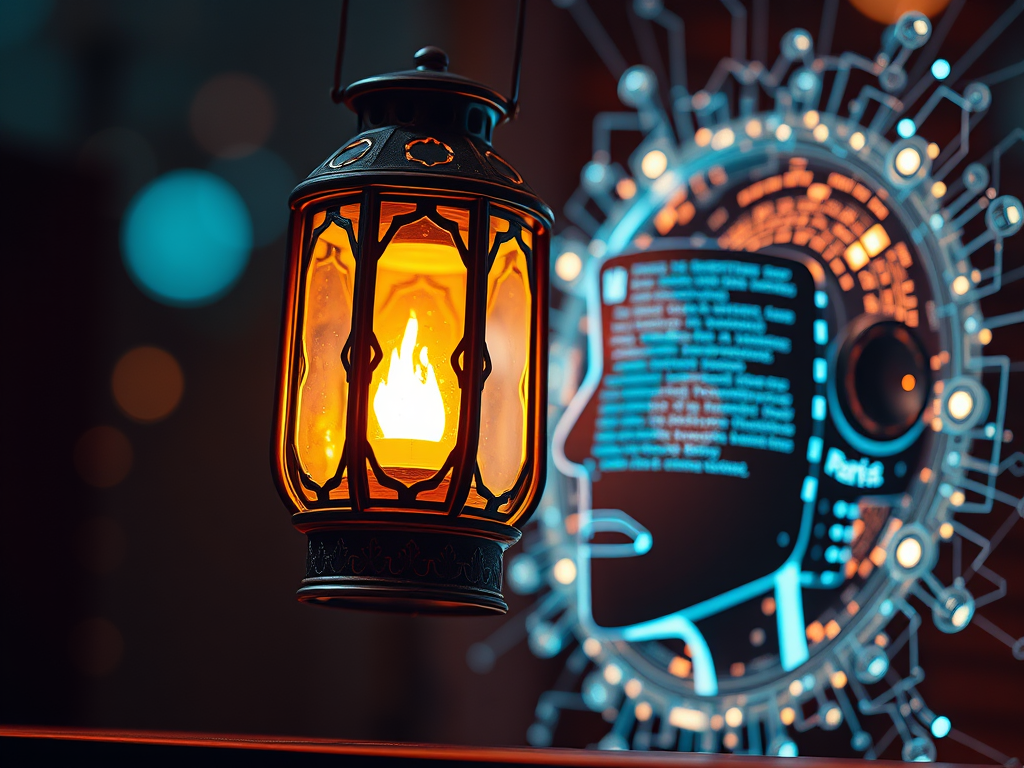
“Machines can be generative. Humans remain generative of meaning.”
We carry stories like small lanterns. We polish them, pass them along, hand them down. Today, one of those lanterns has a new hand on the handle: machines. That fact does not make the work less human, nor does it make it wholly new. It complicates everything — in interesting, difficult, and uncannily beautiful ways.
This essay does not argue whether AI-generated literature is “right” or “wrong.” It simply takes a wide-angle lens: the technical scaffolding, the historical arc, the creative affordances, and the social and legal tensions. Like good criticism, it seeks to name the facets, so we can see them plainly.
A Brief Evolution: From Rules to Attention
The programmatic shaping of text is almost as old as computation itself. Early experiments — from Markov-chain verse to rule-based chatbots like ELIZA — showed that statistical patterning and templates could mimic aspects of human language and narrative, if only at the surface. Wikipedia
The modern surge in generative capability was unlocked by an architectural revolution: the Transformer. Introduced in 2017, this attention-based model reframed sequence modeling and made large, coherent, context-sensitive text generation tractable in a way earlier recurrent models struggled to do. Data Science Dojo
From there came models that scaled — GPT-2, GPT-3, and their kin — each leap widening the field of what a machine could produce in tone, depth, and length. DEV Community
1. Technique and Craft (How It’s Made)
At the core, modern AI literature is statistical patterning on editorial steroids. Models learn the grammar, cadence, and associations of enormous text corpora, then predict what might plausibly follow. That technical truth has two consequences. First, AI can surprise us: in metaphor, rhythm, and the odd, emergent turn of phrase. Second, it is bound to its training data — its “memory” that both enables creativity and imports its biases.
For writers, that means AI is a new kind of tool: capable of producing drafts, recombinations, and suggestions at scale. For editors, it means new editorial muscles — rapid verification, careful contextualization, and a renewed emphasis on selection and curatorial taste.
2. Collaboration and Craft Augmentation
One of the most human outcomes is not replacement but collaboration. Studies suggest that access to generative AI can enrich idea generation and even raise the perceived quality of stories for many writers — especially when the human remains in an active, curatorial role. INFORMS Pubs Online
Yet co-creation is not neutral. The line between prompt and authorship can be porous. When a writer leans on AI for scaffolding, the craft shifts: voice becomes a matter of selection and revision as much as origin. This dynamic asks us to reconsider what creativity looks like in the 21st century.
3. Aesthetic Questions
Does the origin of text change how we read it? Sometimes yes. A poem generated by algorithm might astonish for its cadence yet feel hollow on closer inspection; another might expose new metaphorical juxtapositions a human might never have tried. The real interrogation is artistic: does a piece compel, unsettle, or illuminate? If it does, origin matters less to the reader than experience — but origin matters more to culture, markets, and meaning.
There is also a genre question: AI enables forms that privilege iteration, remix, and modular storytelling. Serialized, branching, and hypertext narratives can be produced faster; micro-poems and associative collage flourish. The machine’s strength is scale and recombination; the human’s is selection and intention.
4. Ethics, Labor, and Attribution
We are in the midst of active, and sometimes messy, public argument about training data, labor, and credit. Many literary professionals worry that uncredited scraping of copyrighted work to train models devalues authors’ labor. Courts and institutions are busy answering these questions — not with perfect unanimity, but with forceful jurisprudence and policy. In one recent ruling, a U.S. appeals court affirmed that purely AI-generated art cannot claim copyright protection under U.S. law because human authorship is required. The Verge
This is more than a legal debate. It is an ethical one about respect for cultural labor. If a model learned from a living writer’s distinct voice, what is the cost to that voice? We must consider compensation, consent, and creative commons in new ways.
5. Markets and Cultural Value
Publishers, platforms, and audiences are recalculating value. On one hand, AI lowers production cost and opens new niches. On the other hand, scarcity and craft may become premium markers: works that reveal sustained human labor, research, and idiosyncratic vision could gain cultural weight precisely because they resist mechanization. The market is not a single vector; it bifurcates into scale-driven content and artisanal, context-rich writing.
6. The Politics of Taste and Bias
AI mirrors the world it learns from — which means its outputs can reproduce the prejudices and blind spots of its training data. That is a political fact with consequences for representation and voice. Corrective work requires diverse training sets, intersectional editorial sensibilities, and clear labeling so readers understand provenance.
7. The Dynamic Nature: Not Static, Always Becoming
Perhaps the most important facet is motion. AI literature is not a fixed object in our culture; it is a process. Models will change. Laws will change. Markets will change. What we read next year will be influenced by technological advances, but also by human response — by artists, lawyers, and editors insisting on ethics, transparency, and care.
In Closing: A Pragmatic Invitation
We do not need to choose between alarm and romance. The sensible path is curious stewardship. Name the facets; test the limits; insist on credit where credit is due; and use these tools to sharpen the human capacities we still prize — judgment, empathy, and discernment.
If you are a writer: try collaboration, but keep the pen in your hand.
If you are an editor: develop new criteria for craft that account for provenance and intent.
If you are a reader: ask about origin, and judge by experience.
Machines can be generative. Humans remain generative of meaning. That distinction is small in technique, enormous in consequence.
Sources and Further Reading
Key materials informing this essay include foundational technical and public sources on the Transformer architecture and the rise of large language models, policy analyses by the U.S. Copyright Office, and empirical studies on human–AI co-creation. Notable references:
- Vaswani et al., “Attention Is All You Need” (2017) — foundational Transformer paper. Wikipedia
- OpenAI’s discussion of GPT-2 and its release choices. Data Science Dojo
- U.S. Copyright Office 2025 guidance on AI-generated works and human authorship. U.S. Copyright Office
- Recent appellate rulings on AI authorship. The Verge
- Empirical discussion on AI-assisted writing and creativity. INFORMS Pubs Online
This article has been generated using AI. The outline, flow and research were created by human intelligence. The actual process was done by AI.

Leave a Reply