
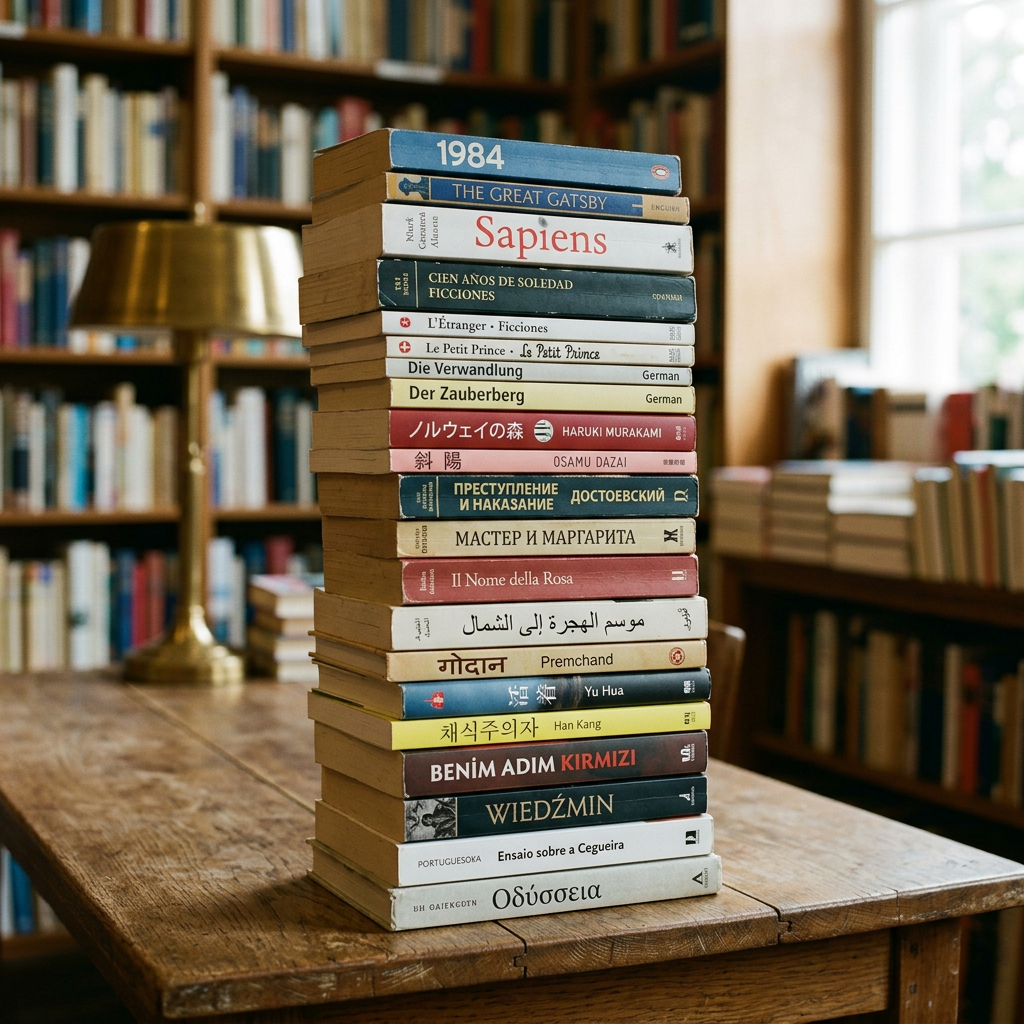
Why reading across languages does more than build literacy, it deepens empathy, sharpens interpretation, and strengthens the mind.
In a world that often rewards speed over depth, multilingualism offers something increasingly rare: perspective.
When children and adults encounter literature in more than one language, they are not merely expanding vocabulary or improving pronunciation. They are learning how meaning shifts across context, how ideas travel differently through culture, and how truth itself can wear more than one linguistic shape. That process does more than create capable readers. It helps shape more rounded, more holistic individuals, people who learn to think with nuance rather than impulse.
Literature, at its best, has always been an invitation into another consciousness. Add multilingualism to that experience, and the invitation becomes even richer. A reader moving between languages begins to notice what monolingual reading can sometimes conceal: that no word is ever entirely neutral, no phrase entirely fixed, and no worldview entirely complete.
Language Expands Thought
One language may carry tenderness in a way another expresses more directly. One may hold respect in its grammar, another in tone. One may preserve ancestral memory in idiom, while another frames modernity with crisp efficiency. To read across languages is to recognize that human experience cannot be flattened into a single verbal system.
That recognition matters deeply for intellectual development.
Critical thinking begins with the ability to hold more than one possibility in the mind at once. It asks us to compare, interpret, infer, evaluate, and reconsider. Multilingual literature trains exactly these muscles. A reader navigating stories across languages must constantly assess meaning beyond the surface. What is gained in translation? What is softened? What remains untranslatable? Why does a character sound more formal in one language and more intimate in another?
These are not passive reading habits. They are acts of analysis.
How Multilingual Reading Strengthens Critical Thinking
Multilingual literary exposure naturally strengthens cognitive flexibility. It teaches readers to move between frames of reference without panic. It encourages comfort with ambiguity. It fosters patience with complexity. Rather than rushing toward the first obvious interpretation, multilingual readers often learn to pause, examine, and question.
That pause is where mature thinking begins.
When readers are trained to notice subtle differences in tone, meaning, and cultural context, they become better interpreters not only of stories, but of the world around them. They become more careful thinkers, more discerning readers, and more thoughtful communicators.
Literature, Identity, and Emotional Intelligence
There is also a profound emotional dimension to this kind of reading.
A person shaped by multilingual literature often develops a more layered sense of self and others. They learn that identity is not singular and sealed, but evolving, contextual, and enriched by overlap. A child who hears one language at home, another at school, and encounters both in stories begins to understand early that belonging can be multiple.
That realization can cultivate empathy, not as a slogan, but as a lived mental habit.
Such readers become more capable of understanding contradiction, more generous toward difference, and less threatened by unfamiliarity. This is part of what makes multilingualism so powerful in literature. It does not simply inform the mind. It enlarges it.
The Power of Multilingual Literature for Young Readers
For young readers especially, this can be transformative.
Children raised around multilingual stories often become more attentive readers because they are accustomed to context clues, tonal shifts, and layered meaning. They learn to listen closely. They become better at detecting pattern, intent, and subtext. These are literary skills, yes, but they are also life skills.
The same child who learns to navigate multiple linguistic worlds in a story may grow into an adult better equipped to navigate social complexity, cultural diversity, and competing ideas with discernment rather than defensiveness.
Why Multilingual Literature Is Not a Luxury
This is why multilingual literature should never be treated as ornamental, niche, or secondary. It is not a decorative extra in a child’s education or an identity checkbox on a bookshelf. It is a rigorous intellectual gift.
It invites readers to think beyond binaries, to notice what others overlook, and to develop a fuller internal life.
When readers see characters thinking, grieving, joking, remembering, and dreaming in different languages, they absorb a broader architecture of human experience. They begin to understand that intelligence is not always loud, direct, or culturally familiar. Wisdom may arrive in a proverb. Humor may rest in rhythm. Emotional truth may live inside a phrase that resists perfect translation.
Exposure to these patterns builds interpretive sensitivity, and interpretive sensitivity is one of the quiet foundations of sophisticated thought.
Final Thoughts
To read literature through the lens of multilingualism is to be reminded that the world is larger than one’s first language, one’s immediate environment, or one’s inherited assumptions. It teaches humility. It sharpens perception. It deepens interpretation. It forms individuals who are not only more articulate, but more reflective. Not only more informed, but more humane.
In an age of oversimplification, multilingual literature offers resistance. It trains readers to dwell in richness, to honor complexity, and to think with care.
That is how it shapes rounded individuals.
That is how it strengthens critical thinking.
And that is why it matters, not only in literature, but in the making of thoughtful human beings.
